
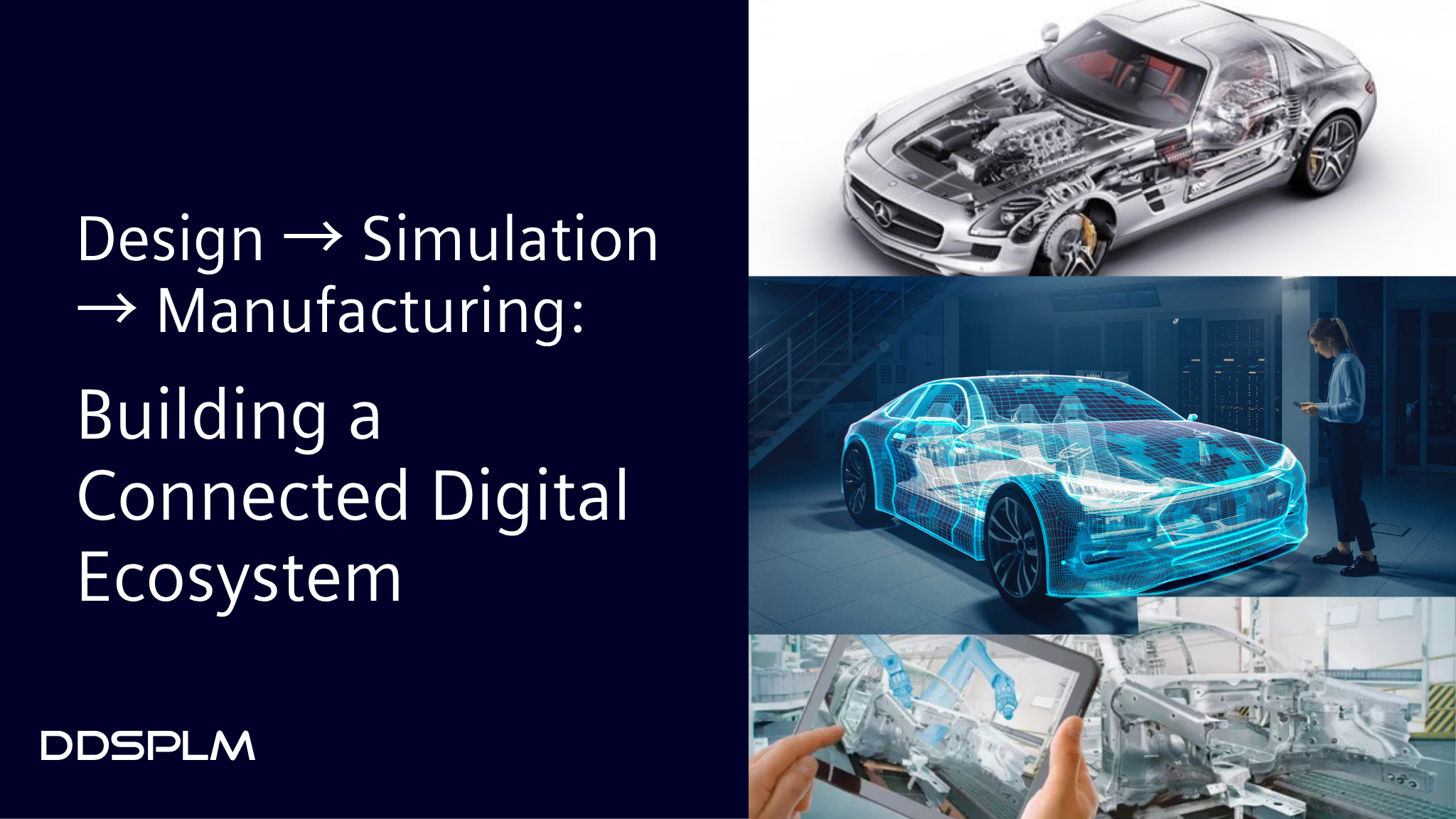
Design, simulation, and manufacturing are usually three islands of engineering organizations. The design team works in CAD. The simulation team publishes files, reimports them to their tools, and analyses them. Drawing is received by the manufacturing, which is frequently obsolete by the time it gets there, and then it builds on it. When something is out of order on the shop floor, the cycle is repeated. Such a detached mode of operation is not only inefficient. It is costly, inaccurate, and more challenging to maintain in a market which requires shorter development times of products and zero-defect product delivery. It is a digital ecosystem that is connected - not three distinct phases of making design, simulating, and manufacturing a product, but a single continuous, data-driven process.
What Is a Connected Digital Ecosystem?
A connected digital ecosystem is an interconnected environment in which all the product development phases, including the initial sketch of the idea to the finished manufactured component, are working on a common, live data platform. Rather than working on files, different teams take them via emails, shared drives, or manual transfer, the data transfers automatically. In case a designer changes a component, the simulation model changes. Once a change in design is proven by simulation, the manufacturing is immediately provided with the new specification. This is the type of connected environment that we are working with in DDSPLM to implement in the engineering and manufacturing organizations around India with Siemens industry leading PLM solutions.
Why the Old Way of Doing Things Is Failing Engineering Teams.
The conventional siloed practice generates three serious issues.
1. Mistakes are compounded during handoffs
Whenever data is transferred between teams manually, it could become mismatched in version, lost, or miscommunication may occur. A change in design implemented on Tuesday might not get to the simulation team till Thursday - a time when two more changes are implemented.
2. Rework costs time and money
In cases where manufacturing finds only a design issue that simulation ought to have been able to demonstrate, or where simulation findings rely upon an old CAD model, the expense of rework grows exponentially. Research has always indicated that errors that are repaired in the manufacturing process would cost ten to a hundred times beyond what it would cost to detect them during the design phase.
3. Speed suffers
Time to Market is a strategic advantage in competitive markets such as automotive, aerospace and industrial machinery. Unlinked processes contribute weeks to product development cycles. Interrelated ecology shrinks such periods to a crawl.
The 3 Pillars of a Networked Digital Ecosystem
1. Downstream Awareness Design.
Design in a connected ecosystem is not only the development of geometry. Each choice of design has downstream consequences- accuracy of simulation, manufacturability, to cost. In real-time, when the designers are operating within a connected PLM environment, such as Siemens NX, the implications can be viewed. Design for Manufacture and Assembly (DFMA)-principles are not applied as an additional consideration to the workflow.
2. Simulation As Part of the Design Process
The greatest change in present-day engineering is the transition between simulation as a validation tool to simulation as a design tool. By integrating simulation with the design environment, that is, not as a secondary process, engineers are able to test concepts earlier, develop much faster, and reach optimized designs earlier than a single prototype has been built. This is the frontloading simulation principle. Simulation software such as Simcenter FLOEFD, which is included in DDSPLM, enables design engineers to compute fluid flow and thermal systems in their own CAD environment – without having any experience in CFD.
3. Production Connected to the Digital Thread
The last phase is the looping between digital technology design and physical production. With manufacturing systems getting their orders straight off the approved digital model, instead of off the printed drawings or the Emailed files, there are no errors whatsoever and the production rate goes up. An MES linked to your PLM environment makes sure that the shop floor is operating off the most updated and correct information. Modifications are spreading immediately. Quality assurances are linked to specifications of designs. The electronic pathway extends throughout the idea to the final component.
Real Business Impact
Companies that adopt a networked digital ecosystem will always have quantifiable results: shortened development time, cut in the number of design cycles, reduced prototype expenses and higher first time right in manufacturing. More to the point, they create a base for ongoing improvement. A single data environment between design, simulation, and manufacturing, all product cycles can result in insights that can improve the next one and make it even faster.
The way DDSPLM can assist you in creating this ecosystem
DDSPLM is a reliable Siemens Digital Industries Software Gold expert partner that has more than 25 years of experience in assisting Indian engineering and manufacturing organizations to adopt PLM, CAD, simulation and manufacturing solutions. We do not just sell software. We collaborate with your team to learn about your existing workflows, the gaps in them, and create an interconnected digital ecosystem that fits your business, both at the time of initial deployment and/or support and optimization.
The future of engineering is connected. Is your organization ready? Contact Us Now